
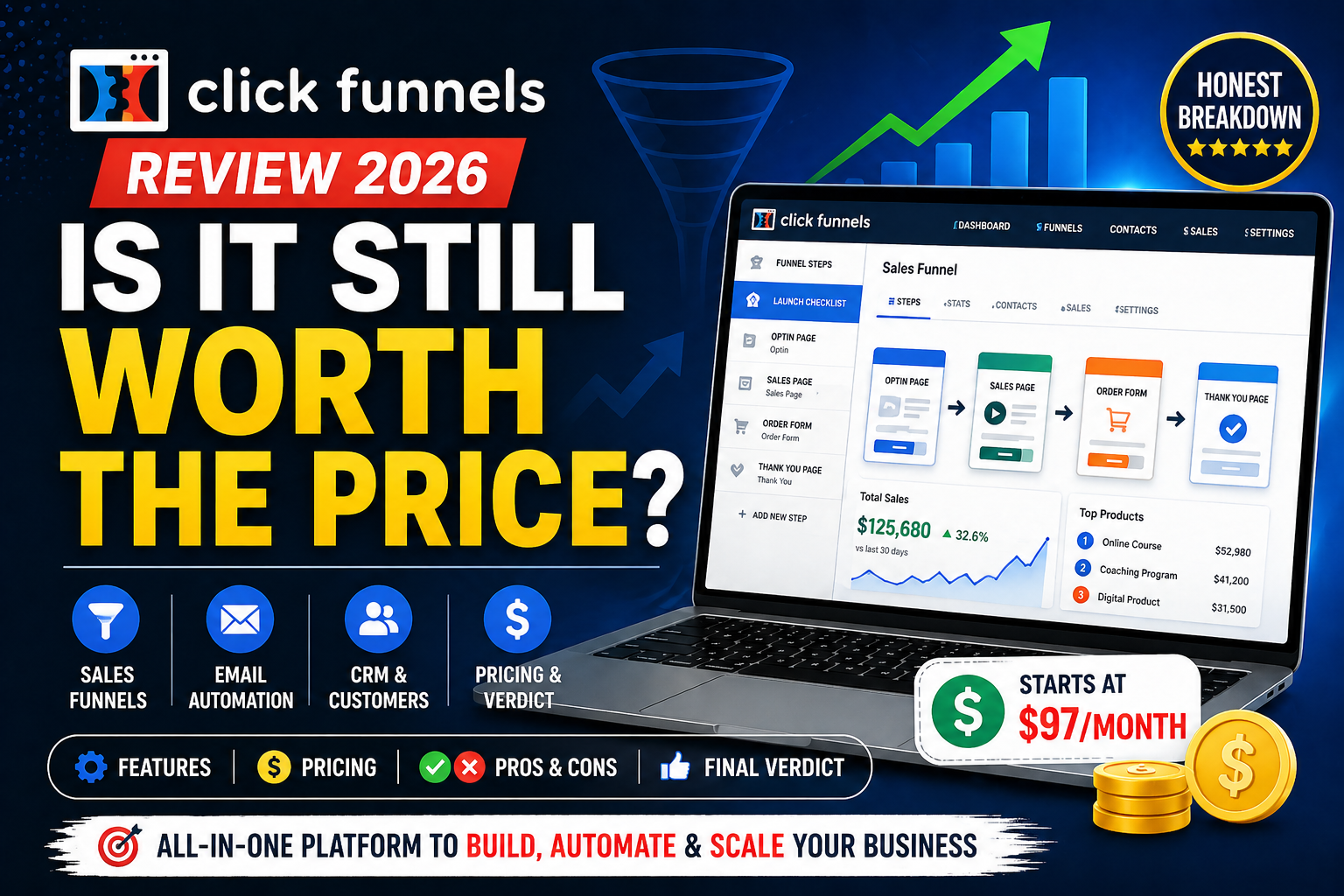
If you’ve ever tried building an online business, you already know the struggle.
Landing pages here… email tools there… payment systems somewhere else.
Everything feels disconnected—and expensive.
That’s exactly where ClickFunnels comes in.
It promises to replace all those tools with one powerful system.
But here’s the real question in 2026:
Is ClickFunnels still worth its high price—or just overhyped marketing?
After testing it (and comparing it with cheaper alternatives), here’s the honest breakdown.
If you’re still exploring tools, check out our guide on the best email marketing tools to compare beginner-friendly options before investing in ClickFunnels.
Table of Contents
What is ClickFunnels?
ClickFunnels is an all-in-one sales funnel builder designed to help you:
- Capture leads
- Build landing pages
- Sell products/services
- Automate follow-ups
All without coding.
It was launched in 2014 and quickly became popular among marketers and course creators.
My Experience Using ClickFunnels
When I first used ClickFunnels, the biggest advantage was speed.
Instead of setting up 5 different tools, I could:
- Build a funnel in a few hours
- Add upsells and order bumps
- Connect email automation instantly
But…
It wasn’t as “easy” as ads claim.
There’s definitely a learning curve, especially if you’re a beginner.
Key Features of ClickFunnels (2026)
1. Sales Funnel Builder (Core Feature)
This is where ClickFunnels shines.
You can create:
- Lead generation funnels
- Sales funnels
- Webinar funnels
- Membership funnels
And everything is optimized for conversions.
2. Drag-and-Drop Page Builder
- No coding required
- Pre-built templates
- Fast funnel setup
Perfect for beginners—but limited for advanced customization.
3. Built-in Email Marketing & Automation
You don’t need tools like MailerLite or ConvertKit.
ClickFunnels includes:
- Email campaigns
- Automation workflows
- Follow-ups
While ClickFunnels includes built-in email marketing, tools like MailerLite and ConvertKit offer more flexibility for creators.
4. Membership & Course Hosting
You can:
- Sell online courses
- Create membership sites
- Deliver digital products
5. CRM & Customer Center
ClickFunnels now includes:
- Contact management
- Purchase tracking
- Customer data
ClickFunnels Pricing (2026)
Here’s where most people hesitate.
- Starts at $97/month
- Can go up to $197/month or more, depending on features
Typical plans include:
- Unlimited funnels
- Limited contacts
- Email limits
- Automation features
But in reality…
Most users end up spending $150–$250/month with integrations.
If ClickFunnels feels expensive, you may want to explore a more affordable ClickFunnels alternative that offers similar funnel-building features.
Pros and Cons
| Pros | Cons |
| All-in-one platform (funnels, email, CRM) | Expensive for beginners |
| Powerful funnel builder | Steep learning curve |
| High-converting templates | Slow page loading reported by users |
| Built-in automation | Limited customization |
| No coding required | Can feel overwhelming |
If your main focus is email marketing, you should also read our detailed ConvertKit vs MailerLite comparison.
What ClickFunnels Does Better Than Others
- Focus on conversion optimization
- Built specifically for sales funnels
- Strong ecosystem (training + community)
This is why it’s still widely used by marketers.
Where ClickFunnels Falls Short
Let’s be honest—this isn’t a perfect tool.
1. Price vs Value
For beginners, ₹8,000–₹20,000/month is a big investment.
2. Complexity
Many users underestimate how much time it takes to learn.
3. Performance Issues
Some users report:
- Slow loading pages
- Automation glitches
- Tracking inconsistencies
Real User Insights (From Reddit)
Here’s what actual users say:
“ClickFunnels works, but it does not work automatically.”
“Pricing and complexity are the biggest issues.”
“Great for funnels, but not a complete business solution.”
That’s the reality—it’s powerful, but not beginner-friendly.
Who Should Use ClickFunnels?
Best For:
- Digital product sellers
- Course creators
- Affiliate marketers
- Agencies running paid ads
Not Ideal For:
- Beginners with low budget
- Bloggers
- Simple websites
- SEO-focused businesses
Is ClickFunnels Worth It in 2026?
✔ YES, if:
- You want an all-in-one funnel system
- You’re running paid ads
- You care about conversions
❌ NO, if:
- You’re just starting out
- You want a cheap tool
- You only need email marketing
Before you decide, don’t miss our Systeme.io review, where we compare a free funnel builder alternative to ClickFunnels.
Final Verdict
ClickFunnels is still one of the most powerful funnel builders in 2026.
But it comes with a trade-off:
Power + Convenience = Higher Cost + Complexity
If you know what you’re doing, it can scale your business fast.
If not, it can feel overwhelming and expensive.
FAQ’s
1. What are ClickFunnels used for?
ClickFunnels is used to build sales funnels that guide visitors from first interaction to final purchase. It helps businesses:
Capture leads
Sell products or services
Create landing pages
Automate email follow-ups
Increase conversions
Instead of using multiple tools, ClickFunnels combines everything into one platform.
2. Is ClickFunnels better than Shopify?
ClickFunnels and Shopify serve different purposes.
ClickFunnels is designed for sales funnels and marketing automation
Shopify is built for eCommerce stores and product management
ClickFunnels is better if you:
Sell digital products
Run funnels and landing pages
Focus on conversions
Shopify is better if you:
Run a full online store
Sell physical products
Need inventory and shipping management
So, ClickFunnels is not “better”—it depends on your business model.
3. Who is the CEO of ClickFunnels?
The CEO and co-founder of ClickFunnels is Russell Brunson, a well-known digital marketer and entrepreneur.
He is also the author of popular marketing books like DotCom Secrets and Expert Secrets.
4. What does ClickFunnels cost?
ClickFunnels pricing typically starts at:
$97 per month (basic plan)
Higher plans go up to $197/month or more
The cost depends on features like:
Number of funnels
Contacts
Email automation
Advanced tools
For beginners, it can feel expensive compared to alternatives.
5. What are the 4 funnels of marketing?
1. Lead Generation Funnel–
Collects emails using landing pages or free offers
2. Sales Funnel–
Converts visitors into paying customers
3. Webinar Funnel–
Uses webinars to educate and sell
4. Membership Funnel–
Delivers paid content like courses or subscriptions
Each funnel serves a different stage of the customer journey.